If you’ve ever traveled by train in Russia, you probably remember the characteristic rhythm of the road: “tuk-tuk… tuk-tuk…”.

Butt and buttless paths
This sound accompanies the trip almost all along the way and for many has become an integral part of the atmosphere of railway travel. But it’s worth taking a train ride in Europe, Japan or China, and you’re surprised: the train runs almost silently, without the usual knocking.
The reason lies not in the trains themselves, but in the design of the railway tracks.
Where does the famous “tuk-tuk” come from
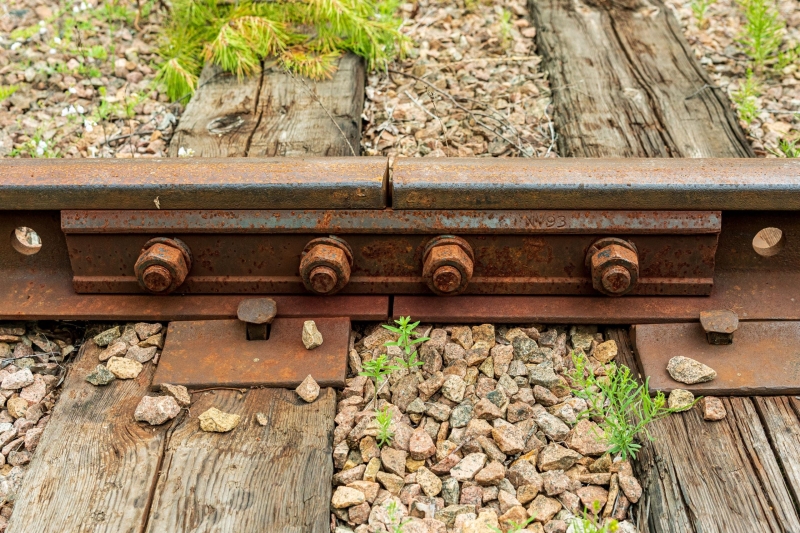
For a long time, many railways, including in Russia, used joint track construction.
The rails are laid in separate sections with a length of approximately 12.5–25 meters, and small gaps are left between them.
This is due to the usual physics of metal:
- in summer, the rails expand
- in winter they contract
- without gaps, the metal could bend or deform
When the train wheel passes the junction of the two rails, a small bump occurs. Then the wheel passes through the next joint and the impact repeats.
This is how the familiar rhythm of the railway appears:
tuk-tuk… tuk-tuk…

The connecting path
Why is there almost no knocking in Europe, China and Japan
Today, a joint-less track is widely used in many countries.
The rails are welded together in long continuous lines. Sometimes the length of such a rail reaches several kilometers.
The wheels of the train move almost along a solid metal strip, so the bumps at the joints disappear.
This has several advantages:
- almost no wheel impacts
- significantly less vibration
- movement becomes smoother
- noise level is reduced
Therefore, on trains in Europe, China or Japan, passengers often hear only a slight rustle of movement, even at high speed.

Seamless track
What happens to rails in heat and frost
A logical question arises: if the rails are welded into a long line, then how is the problem of thermal expansion solved?
Modern technology uses several solutions.
Firstly, the rails are laid at a so-called neutral temperature— usually around 20-30 °C. At this point, the metal is roughly in the middle between future expansion and contraction.
Secondly, the rails are rigidly fixed:
- on reinforced concrete sleepers
- with special powerful fasteners
- through elastic gaskets
- on a dense crushed stone base
Temperature changes are distributed over the entire length of the rail and create internal stresses that the structure is designed to withstand.
Special expansion compensators are installed on bridges, arrows and some technical sections.
What is happening on modern lines in Russia
Russian railways are gradually switching to modern technologies.
A seamless path is already used on many main sections.
New lines apply:
- long welded rails
- reinforced concrete sleepers
- elastic rubber gaskets
- vibration reduction systems
Therefore, on high-speed train routes, for example “Peregrine Falcon”, the movement is already noticeably quieter and smoother.
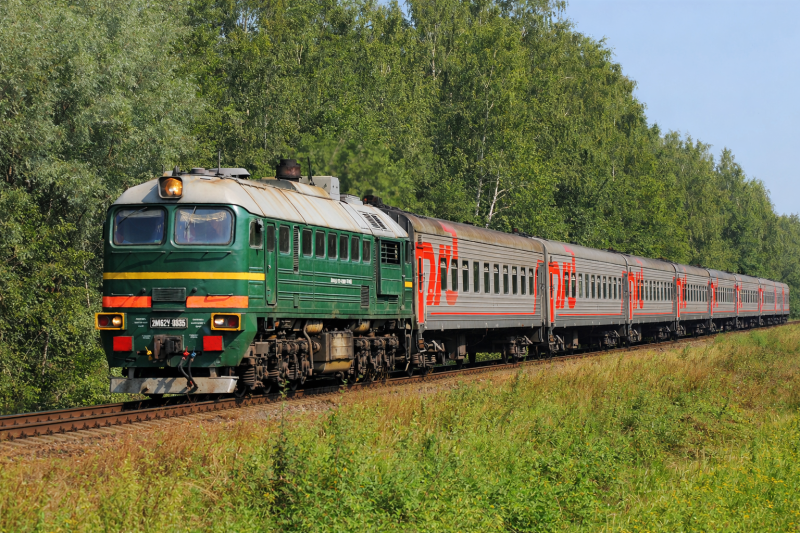
Why do trains rattle their wheels in Russia
Why will the knocking be heard for a long time anyway
Russia has one of the largest railway networks in the world — tens of thousands of kilometers of tracks.
A complete modernization of such an infrastructure requires huge investments and time. Therefore, traditional butt rails are still used in many areas.
That is why, when traveling around the country, we still hear the familiar rhythm of the road.
For engineers, this is just a feature of the track design, and for passengers, it is one of the most recognizable sounds of railway travel.
Why do trains rattle in Russia, but in Europe, China and Japan there are almost none?
