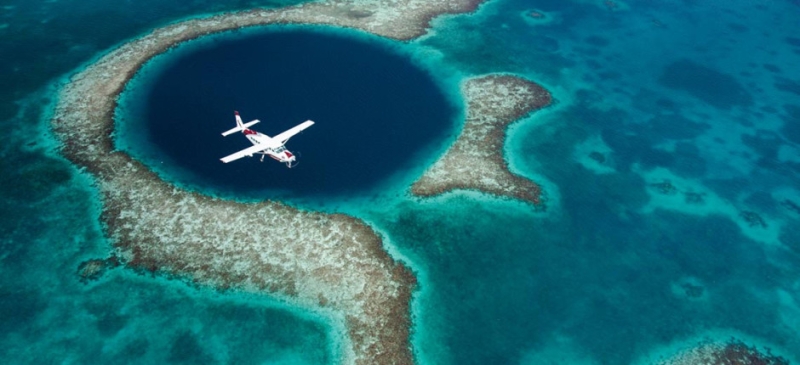
There are places that you can recognize at a glance, even if you’ve never been there. For me The Great Blue Hole is just such a place. A huge dark blue circle in the middle of the turquoise Caribbean Sea looks so unusual that it seems as if you are not looking at a natural object, but a perfectly drawn illustration. But this is a very real place that attracts thousands of travelers, photographers and divers from all over the world every year.
The Big Blue Hole
If you are interested in unusual natural attractions or dream of one day seeing one of the most famous dive sites on the planet, I’ll tell you what the Big Blue Hole is famous for, where it is located and what you should know before traveling.
Where is the Big Blue Hole
The Big Blue Hole is located in the Caribbean Sea, about 70 kilometers off the coast of Belize. It is located in the very center of Lighthouse Reef Atoll, one of the largest coral atolls in the country.
Coordinates:
17°18′55″N, 87°32′04″W
This place is part of the Belize Barrier Reef, which is considered the second largest coral reef in the world after the Australian Great Barrier Reef. The entire reef complex is included in the UNESCO World Heritage List due to its unique biodiversity and natural value.
What is the Great Blue Hole
Despite the name, this is not a hole in the ocean at all, but a huge sinkhole, almost perfectly round in shape.
Its dimensions are really impressive:
- diameter is about 300 meters;
- depth is about 124 meters.
When viewed from above, the border between the light turquoise waters of the reef and the almost inky blue center is so contrasting that it creates the feeling of a bottomless abyss. It is this unusual color that has made the Big Blue Hole world famous.
How the Big Blue Hole formed
The history of this place began long before the appearance of the modern Caribbean Sea.
During the last ice Age, the level of the world’s oceans was significantly lower than the current one. Back then, the territory of the current Blue Hole was on land. There was a large system of limestone caves, inside which stalactites gradually grew and underground halls formed.
Later, the climate changed, glaciers began to melt, ocean levels rose, and the vaults of ancient caves collapsed. This is how a giant flooded sinkhole was formed, which the whole world knows today as the Great Blue Hole.
That is why you can see real ancient stalactites at depth — a rare phenomenon in the underwater world.
Why do tourists come here
Most travelers come here for one of two reasons: to see the Blue Hole from the air or to dive underwater.
World-class diving
For experienced divers, the Big Blue Hole is considered one of the most desirable dive sites.
Already at a depth of several tens of meters, the landscape is noticeably changing. Bright corals are left behind, the water becomes darker, and huge limestone walls appear around. Even lower down are massive stalactites dating back many thousands of years. Some of them reach several meters in length and resemble the columns of a huge underground palace.
During dives, you can meet:
- reef sharks;
- nurse sharks;
- hammerhead sharks in a certain season;
- various rays;
- large groupers;
- giant sea sponges and other reef inhabitants.
Due to the significant depth, currents and diving features, this place is designed primarily for experienced divers.
Aerial view
Even if you don’t go diving, it’s still worth seeing the Big Blue Hole.
Many people believe that it is from a height that the most spectacular view opens. From an airplane or helicopter, an almost regular circle of dark blue color is perfectly visible, surrounded by the light water of a coral reef. The contrast is so strong that it seems as if a huge portal has appeared in the middle of the ocean.
It is no coincidence that aerial photographs of the Great Blue Hole have become the hallmark of Belize and regularly appear in travel guides, documentaries and collections of the most beautiful places on Earth.
National Geographic Research
One of the most famous studies of the Blue Hole was the 2018 expedition.
The National Geographic team, together with Fabien Cousteau, the grandson of the legendary ocean explorer Jacques Cousteau, studied the bottom of the sinkhole using modern underwater vehicles.
The expedition confirmed the presence of ancient stalactites and cave collapse marks, which once again confirmed the origin of this natural site. But the researchers also found less pleasant evidence of human presence — plastic debris found at a depth of about 120 meters. Even such remote corners of the planet are already experiencing the influence of civilization, and this fact makes you think.
How to get to the Big Blue Hole
The trip usually starts from Belize City or from the popular islands of Caye Caulker and Ambergris Caye.
Most tourists choose organized boat trips.
The journey by speedboat takes about 2-3 hours in one direction. Usually such tours include not only a visit to the Blue Hole itself, but also stops at several beautiful sections of the Belize Barrier Reef, where you can snorkel or take additional dives.
For those who want to see the famous circle in its entirety, sightseeing flights on small planes or helicopters are available.
What is useful to know before a trip
If you are planning a dive, there are several important points to consider.
As a rule, diving in the Big Blue Hole is only available to divers with an Advanced Open Water Diver certificate or a similar level of training. This is due to the depth and conditions of the dive.
The price of most tours usually includes:
- boat transfer;
- equipment;
- instruction;
- professional guide;
- meals;
- visiting additional reefs.
Those who don’t dive won’t be bored either. Many people come here solely for snorkeling near the outer edge of the reef, boat trips, photo expeditions or panoramic flyby. Each format allows you to see a Big Blue Hole in its own way.
Is it worth going?
In my opinion, the Big Blue Hole is not just another famous landmark from beautiful photographs. It is interesting not only to admire the unusual view, but also to understand how nature created this gigantic natural object over thousands of years. The history of ancient caves, the power of the ocean and the modern underwater world are wonderfully combined in one place.
Even if you don’t plan to dive into the depths, seeing the Great Blue Hole with your own eyes — from the deck of a boat or from the window of a small airplane — is in itself a memorable experience. There are places that impress not with their size or big names, but with the feeling that nature is capable of creating things that are simply hard to believe at first. For me, the Big Blue Hole is just like that.
